When I ask my clients what they fear most about the end of their lives, almost no one says "death." What they say, over and over, is: I don't want to be a burden on my family. I don't want to die in pain. I don't want to lose my dignity. I don't want to be hooked up to machines for weeks while my kids stress over what to do.
These are not abstract worries. They are the documented top end-of-life concerns of older adults — being a burden tops nearly every survey, followed by fear of a prolonged, painful dying process and loss of independence (AARP research confirms this pattern across thousands of respondents).
And the sad fact is: in our overburdened healthcare system today, every one of those fears is more likely to come true if you do nothing.

The system is straining, and the "default" is not your friend
As many of you know, I am a fierce advocate for choice at the end of life. But right now, our healthcare system is under incredible, unprecedented strain. Due to a chronic lack of funding and resources, many of our most vulnerable citizens are falling through the cracks at the exact moment they need support the most.
The hard truth is that our collective choice has largely been stripped away. There simply are not enough hospices or palliative care units to meet the demand. The federal government's own data shows that while 75% of Canadians say they would prefer to die at home, only about 15% have access to palliative home care services. For those who desperately wish to spend their final days at home, the severe shortage of home-health staff and resources makes it an uphill battle.
I have stood at the bedsides of hundreds of adults as they have passed away. Yes, some were peaceful, natural deaths — the kind of gentle departure we all hope for. But tragically, that is not how some people die today.
I have seen individuals pass suddenly and unexpectedly, right before my eyes or in my arms. I have witnessed others suffer in tremendous pain for weeks, even years. Too often, I see the elderly and frail placed on mechanical ventilators, where their dying process is artificially prolonged. Their passing only takes place when the tubes are finally removed — frequently without a single loved one by their side.
This is not planning, and it is absolutely not choice. And the family left behind carries the trauma of those weeks for the rest of their lives. The very "burden" we try to avoid becomes the lasting memory we leave them with.
Let's change that, for you and your loved ones.
Your legal voice: the only thing that overrides “default.”
For those of you who have not yet completed your vital serious-illness and end-of-life documents, I strongly and urgently encourage you to do so. Over the last few weeks alone, several of my clients with life-ending diagnoses passed away naturally. Most were completely unprepared, which inflicted an immense, avoidable amount of stress on everyone involved.
True advocacy starts with a legal voice. My team and I have written hundreds of Advance Directives designed to align seamlessly with institutional medical orders, specifically the Medical Orders for Scope of Treatment (MOST). This alignment ensures you receive the exact treatments you want — and aggressively blocks the ones you don't.
If you want to understand the legal mechanics behind these documents, the BC Centre for Palliative Care and People's Law School both publish plain-language guides — though I will tell you honestly, the difference between a generic template and a directive built to actually hold up against hospital protocols is night and day.
Furthermore, we help guide you in selecting the right Representative (substitute decision maker). It is a common misconception that your spouse or adult children are automatically the best fit; choosing the right person requires strategy, capability, and objective clarity.
How MOST & Advance Directives are better together
A MOST form is a medical order filled out by a doctor or nurse practitioner (HealthLink BC explains the basics here). Your Advance Directive is what forces the doctor's MOST form to actually reflect your wishes, rather than the hospital's default protocols.
At Patient Pathways, we believe that your medical documentation should reflect the full picture of who you are and how you wish to be cared for. Our experienced, compassionate healthcare navigators provide dedicated, one-on-one support to help you articulate your values and draft an Advance Directive that is fully aligned with your medical orders. Together, we ensure that your clinical directives and personal wishes speak the same language, giving you and your family ultimate protection and true peace of mind for the journey ahead.
These documents work best when they are attached directly to one another. While a MOST document outlines the rigid, technical medical instructions for a healthcare team, an Advance Directive infuses those orders with your unique voice, beliefs, and personal boundaries.
Together, they create a compassionate safety net that combines medical protocols with human dignity. This simple step gives doctors and your loved ones complete clarity, making sure your care always honours your definition of a life worth living while removing stressful guesswork and emotional burdens during a crisis.
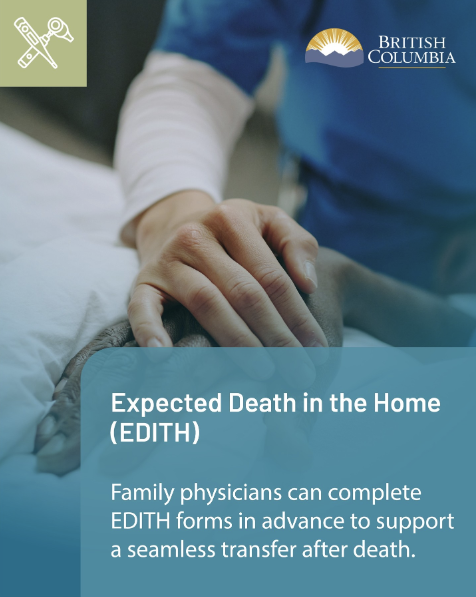
View and download the Expected Death in the Home (EDITH) form in BC, Canada
The EDITH form: the difference between a peaceful home death and a police investigation
If you are nearing the end of your life, and if your plan is to pass away at home — whether naturally or through MAiD — it is vital to have an Expected Death in the Home (EDITH) form in place.
Most people have no idea that without this document, a death at home legally triggers an automatic 911 response, attempted resuscitation by BC Ambulance Services, and an automatic police and coroner investigation. Imagine your spouse, in shock and grief, suddenly managing paramedics, uniformed officers, and questions from the coroner — all because a single form was never signed.
With a current EDITH form (signed by your clinician and valid for 3 months, as outlined here), none of that happens. The funeral home is called. The body is transferred. Your family gets to grieve.
Securing an EDITH form is a crucial step in protecting your peace of mind and ensuring your wishes are strictly honoured.
Take Action Today
Read our foundational guide: Understanding Your Choice at End of Life to learn about your legal rights and options.
Reach out to us: Don't wait for a healthcare crisis. Contact our team to begin mapping out your Advance Care Plan now, so your choices remain protected.
The fear of being a burden, of pain, of indignity — those fears are valid.
The great news is: those fears are largely preventable, with forethought and a little paperwork!
Patient Pathways provides one-on-one support in helping patients access BC healthcare services and determine Advance Healthcare Directives. See our Services and Fees.
Frequently Asked Questions About End-of-Life Forms in BC
What is a MOST form in BC?
A Medical Orders for Scope of Treatment (MOST) form is a clinical order filled out by a BC doctor or nurse practitioner outlining technical instructions for your medical care during a crisis.What is the difference between an Advance Directive and a MOST form?
A MOST form is a medical order written by clinicians, while an Advance Directive is a legally binding document written by you. Your Advance Directive forces the MOST form to accurately reflect your personal wishes rather than institutional defaults.What happens if you die at home without an EDITH form in BC?
Without an Expected Death in the Home (EDITH) form, a natural death at home legally requires emergency services (911) to attempt resuscitation, followed by a mandatory police and coroner investigation.